Color is the element of art that refers to reflected light. Color theory is defined as a theory because it cannot be proved. Theories are generally accepted, despite the fact that they cannot be proven. Laws are accepted because they can be proven.
There are volumes and volumes of information available about color. This page, while thorough, will present color theory in an "easy to understand" fashion. It is an exciting, ever-changing science. Color has an affect over how we feel about objects, how we behave, and how our bodies react to circumstances.
If color theory is simplified, it can be broken down into 3 parts- The color wheel, color value, and color schemes. Each part of color theory builds on the previous. Understanding each section of color theory fully, will help you better understand its importance in the creation of art.
The color wheel was developed by Sir Isaac Newton by taking the color spectrum and bending it into a circle. If you follow around the color wheel, you will find the same order of the color spectrum- red, orange, yellow, green, blue, indigo(blue-violet), and violet. Some remember it by the acronym ROY G. BIV.
The color wheel is made up of three different types of colors - Primary, Secondary, and Tertiary.
The primary colors are red, yellow, and blue. They are called primary for a couple of reasons. First, no two colors can be mixed to create a primary color. In other words, primary colors can only be created through the use of natural pigments. Secondly, all other colors found on the color wheel can be created by mixing primary colors together.
The secondary colors are orange, green, and purple. Secondary colors are created by mixing equal parts of any two primary colors. Yellow and blue will give you green. Red and blue will create purple(violet). Red and yellow will give you orange.
Tertiary colors are created by mixing equal parts of a secondary color and a primary color together. There are six tertiary colors- red-purple, red-orange, blue-green, yellow-green, blue-purple, and yellow-orange. Notice that the proper way to refer to tertiary colors is by listing the primary color first and the secondary color, second.
Click on the image below to check out The Interactive Color Wheel...
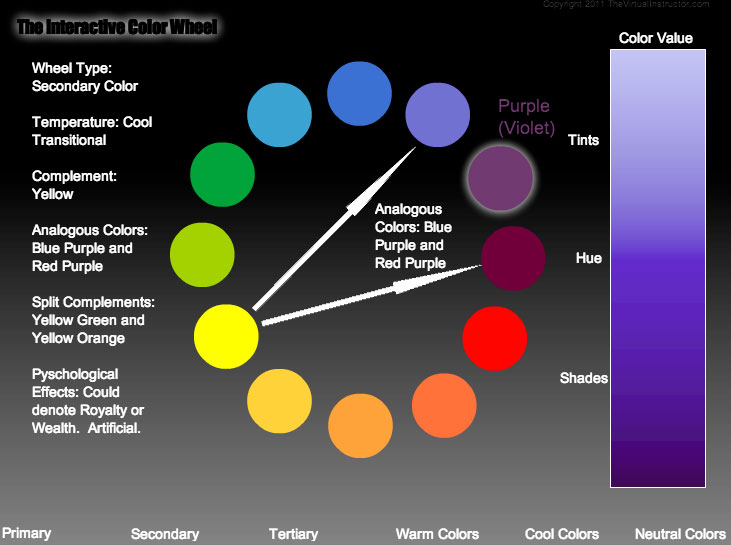
The second part of color theory deals with color values. Value is the darkness or lightness of a color. When dealing with pure color (hue), value can be affected by adding white or black to a color. Adding white to a color produces a tint...

Adding black to a color produces a shade...

When grays are added to the color, the intensity of the color is affected. Intensity is related to value.
Color schemes are ways colors are put together in an intelligent way