Welcome to the definitive guide to drawing trees. This page features four in-depth lessons on how to draw trees using various mediums and approaches.
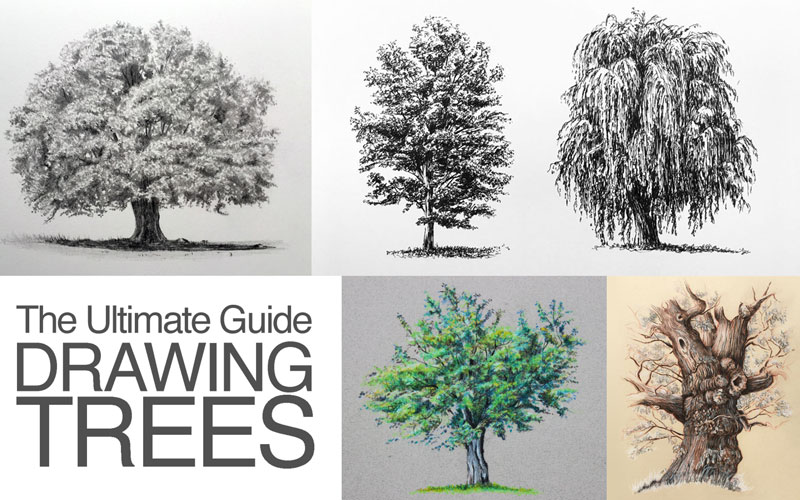
Use the table of contents below to skip to the lesson of your choice or go through each lesson chronologically.
In this lesson, we'll explore a structured approach to drawing a realistic tree with pencil. The approach that I'll share with you can be applied to any species of tree and can even be adapted to drawing bushes and shrubbery. In this approach, we'll examine specific aspects of the tree and apply what is observed to the drawing.
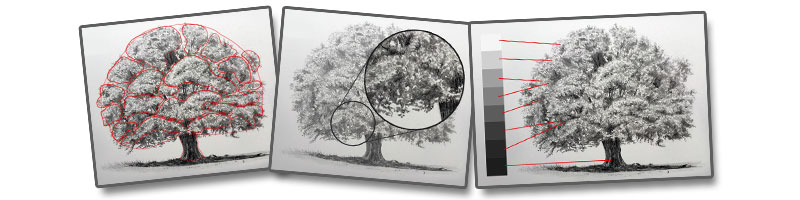
You're likely to find the most success drawing a tree from observation, but you can also apply this method to drawing a tree from your imagination.
In this example, we'll draw the tree using graphite pencils. Three pencils are used, but the pencils that you may use are dependent on the pressure that you typically place on the pencil. Ultimately, you'll need to create a full range of value in the drawing. For this reason, a range of graphite grades are used.
Since texture will play an important role in the drawing, the surface that you choose to work on is important. For this example, Bristol paper (vellum surface) is used. This paper is very smooth, but still has an ample tooth (texture) to accept multiple applications of graphite.
Bristol paper provides a good amount of control over the mark, but the texture in the drawing must be developed through mark-making and value alone. (Detail of texture created on Bristol paper is pictured below left.)
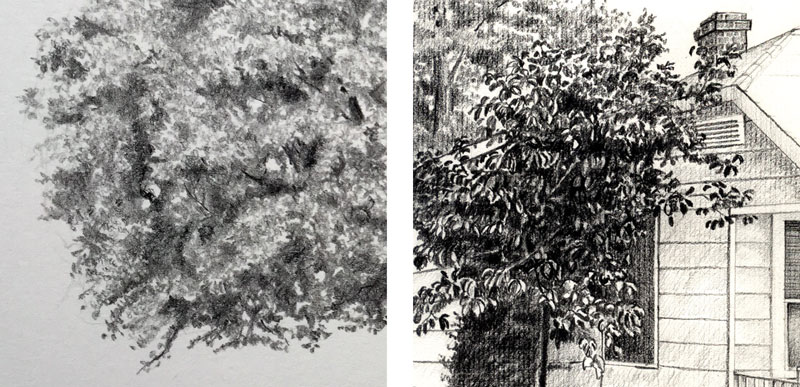
Some will prefer a paper with a greater texture. Working on a surface with a bit more tooth can aid in the development of the texture of the leaves. Charcoal paper is a good solution for those wanting to exploit the surface texture. (Detail of texture created on charcoal paper is pictured above right.)
It's easy to become overwhelmed when you look at a tree. There are so many details! But to draw one accurately, we need not be consumed with these details. Instead, we'll breakdown the tree into three simple aspects. We'll develop each aspect individually, following a structured approach.
Step 1 - Find the Shape(s) - The first thing we'll do is define the overall shape of the tree. Drawing lightly with the 2H pencil, we'll concentrate only on the outer contours.
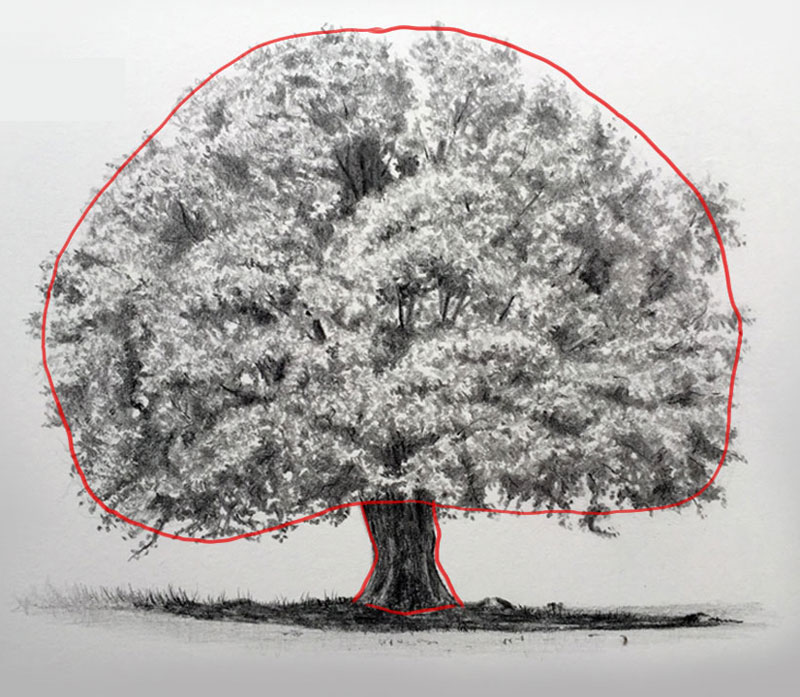
With the outer contours defined, we'll next find the smaller shapes within the canopy of the tree. These locations are "clumps" or collections of leaves found at the end of the branches.
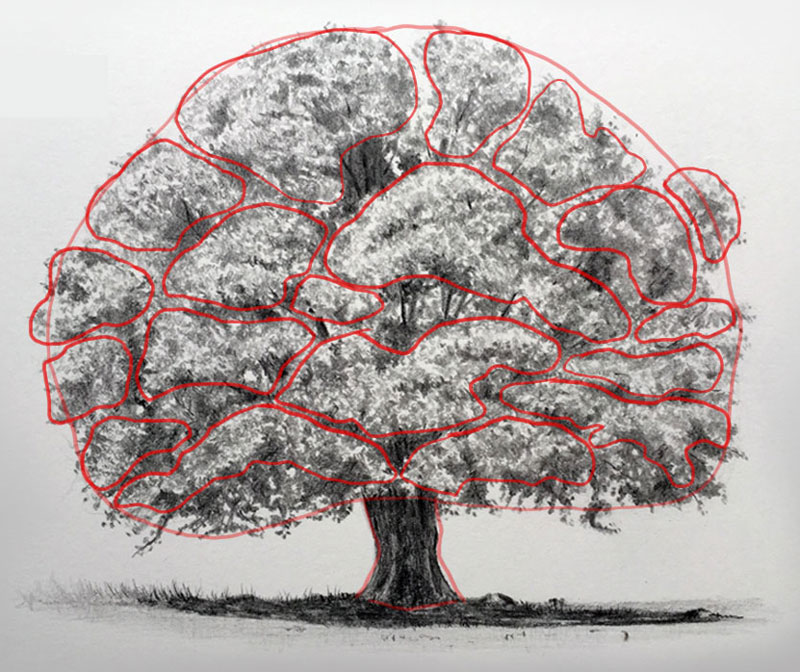
Step 2 - Develop the Texture - Using the defined shapes as a guide, we'll start to develop the texture of the leaves. This process requires patience. Take your time and remain consistent. It is not necessary to draw every leaf, instead we'll create the illusion of collections of leaves. We'll think about each "clump" or collection of leaves as a form, developing the highlights and shadows on each.
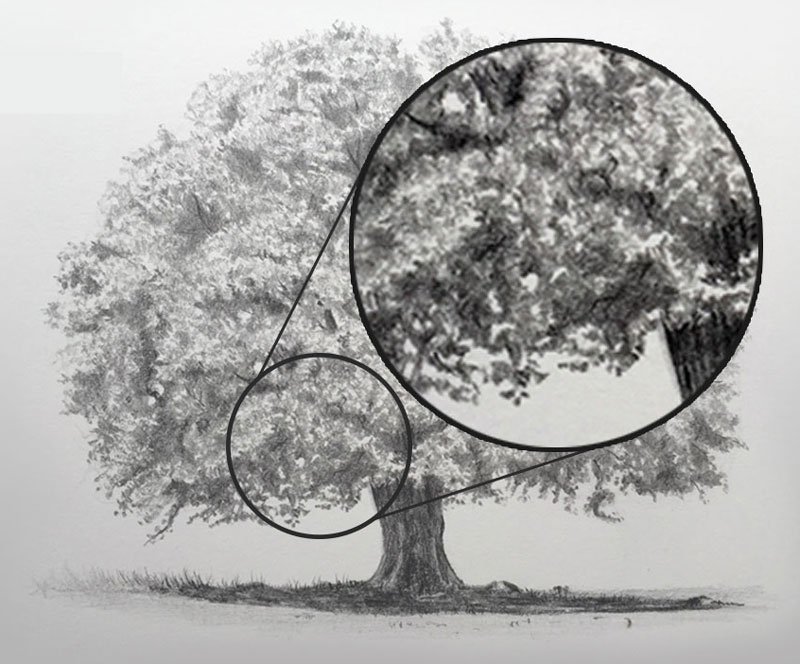
Organic collections of lines can be used to create the illusion of the texture. These lines may be small squiggles that overlap. Be sure to leave an organic and irregular edge around the outer contours of the tree and leave small open spaces within the canopy.
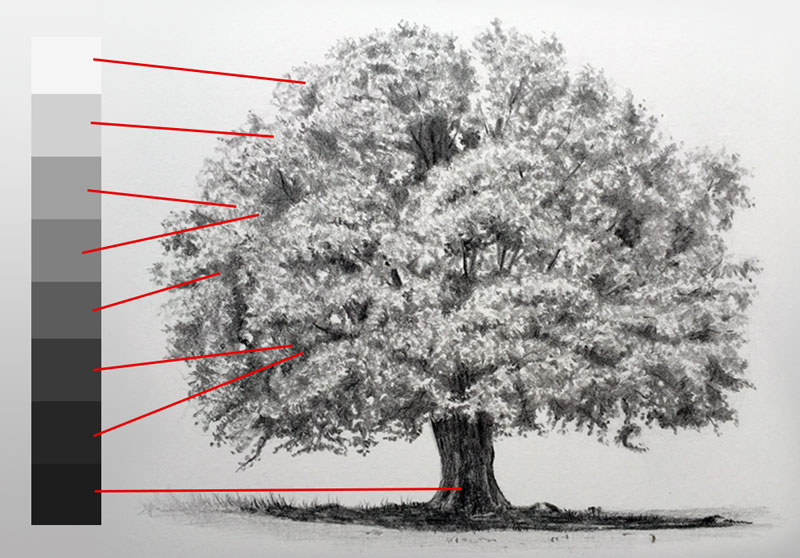
Step 3 - Develop the Value - The illusion of texture is created not only by the marks that are made, but also through the development of the values. Value is the darkness or lightness of a color. It is responsible for communicating not only the light within the scene, but also the form and texture of the object. Our goal is to create a full range of value, including the darkest "darks" and the lightest "lights".
1. Take Your Time - As mentioned before, drawing a realistic tree requires patience and persistence. (This is really true for any subject that you draw.) Far too many people believe that drawing should be quick and easy. Sometimes just "slowing down" and patiently developing the drawing leads to considerable improvement.
2. You Are Creating an Illusion - Drawing is an act of illusion. It is the development of the shapes, textures, and value that create this illusion. There's no need to draw everything that you see. Instead, concentrate on how you can create the illusion of what you see.
3. Deviations are Acceptable - When drawing from observation, deviations from the original reference or subject are inevitable. Creating an exact copy of your subject probably shouldn't be your goal. Don't put unnecessary pressure on yourself to be "perfect". This will just lead to frustration.
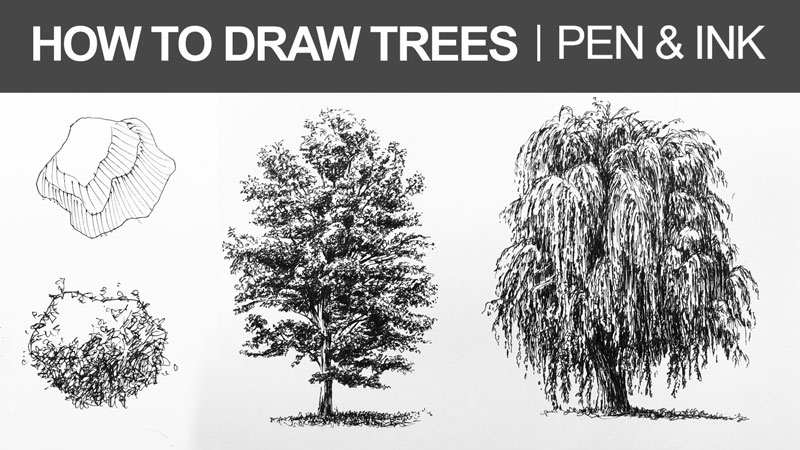
When we create a drawing of a tree with pen and ink, we'll consider the same basic elements. Remember, the details that we see - the leaves, branches, and trunk can all be simplified, making the illusion that we create in a drawing a bit more manageable. When we draw, we create an illusion - not always an exact copy of what we see.
Just like with graphite drawing, creating this illusion in a pen and ink drawing can be accomplished by focusing on three key elements:
The following video demonstrates how to draw a tree with pen and ink by focusing on these three basic elements.
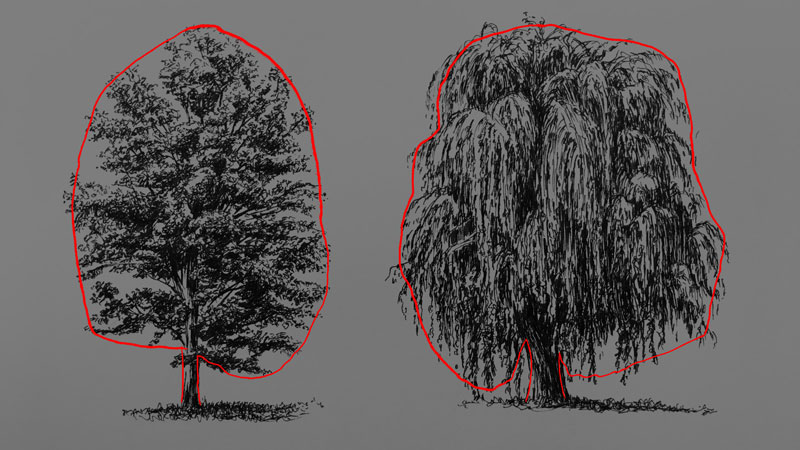
Trees are clearly organic subjects and the shapes that they create are also organic. The first thing that we need to recognize is the overall shape of the tree which will vary based on the type of tree that you are drawing.
To recognize the shape of the tree, look at the overall contour of the shape. If you struggle with seeing this, try squinting your eyes - blurring out the details. Look at the outer edges of the tree and simplify what you are seeing into a line that can be enclosed.
This overall shape can be loosely sketched with a graphite pencil. Use a light touch so that the graphite can be erased easily once ink applications have been made. Make comparisons between your drawing and what you are seeing and make any necessary changes.
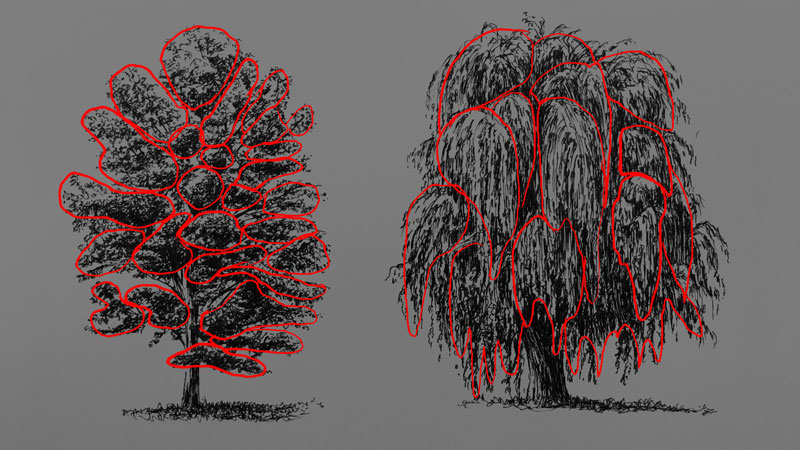
With the basic contour in place, we can begin to locate smaller shapes that happen within the body of the tree. Trees are made up of collections of leaves and branches that extend from the trunk. These collections of leaves and branches are forms but before we develop the illusion of these forms, we must recognize the basic shapes that they create.
Again, these basic shapes can be lightly sketched with a graphite pencil. We aren't concerned with the details of the leaves at this point. Instead, we just want to simplify the collections of leaves into basic shapes. The shapes that you draw will again vary based on the type of tree that you are drawing.
If you find that recognizing these basic shapes is difficult, try looking for areas of contrasting values. Typically, darker values are found on the lower portion of each shape with lighter values on the top.
Now, we need to create the illusion of form. In order to create this illusion, we'll need to consider the light source and add darker values in locations of shadow while leaving areas of lighter value in locations of highlight. The key to creating the illusion of form with any subject lies in the locations of value.
For each of the smaller shapes that we drew in the last step, we'll add darker values in the locations of shadow. These areas of shadow exist mainly on the opposite side from where the light source originates. And like with basic forms, there will be a gradation of value from light to dark, creating locations of midtone. Since these forms are irregular, the locations of shadow and middle values are also irregular.
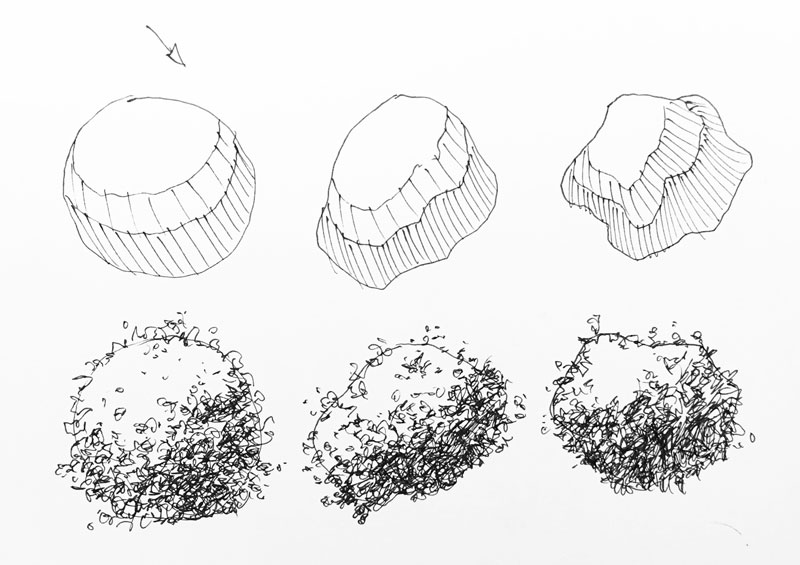
These values are added and developed through textural marks that resemble the texture of the leaves. Textural marks are more concentrated in locations where the value is darker and more sparse in areas where the value is lighter.
When drawing with pen and ink, the values that are created are mostly dependent on optical mixing. Since every mark is dark, even when applied with light pressure, we must rely on the white of the paper to affect the perceived value. This is important to remember since we are building up the value as we develop the texture.
It's easy to become focused on each individual leaf when drawing a tree. But in our drawing, we don't need to draw every single one. Instead, we need to mimic the texture that is perceived. Surprisingly, this can be accomplished with very loose marks with pen and ink.
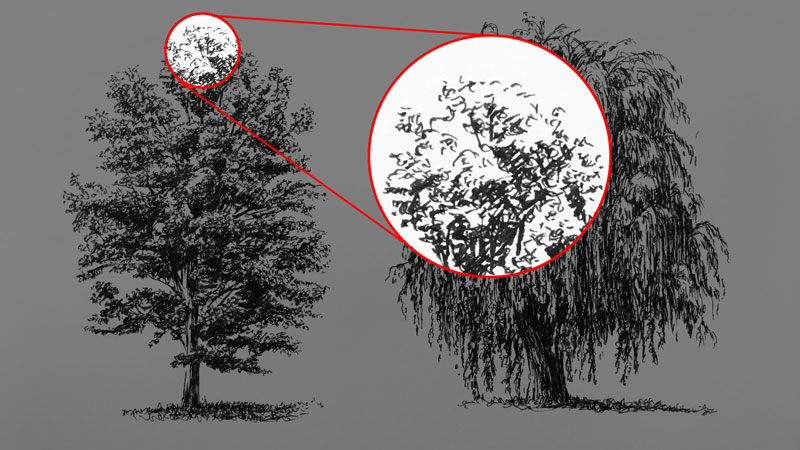
With many species of trees, small squiggly lines made with the pen can create a convincing texture.
No matter what type of pattern you decide to use for developing the texture, it's important to stay consistent. Make sure that the marks that you add to the top of the tree are consistent with the marks that are used to describe the middle and bottom of the tree.
Even though loose, squiggly marks result in a believable texture, it doesn't mean that this process is fast. Take your time and patiently develop each section. Take breaks if necessary. Working slowly will pay off in the end.
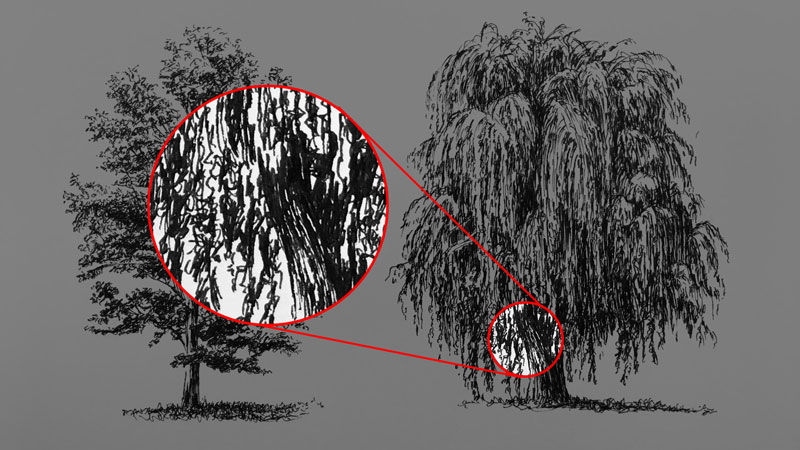
Directional strokes can be used to develop the texture of the trunk of the tree. Again, we can concentrate these marks in areas of shadow and allow them to become more sparse in areas where light is hitting.
Even a subtle change in the textural marks that you make will produce enough contrast to communicate a different texture in the drawing.
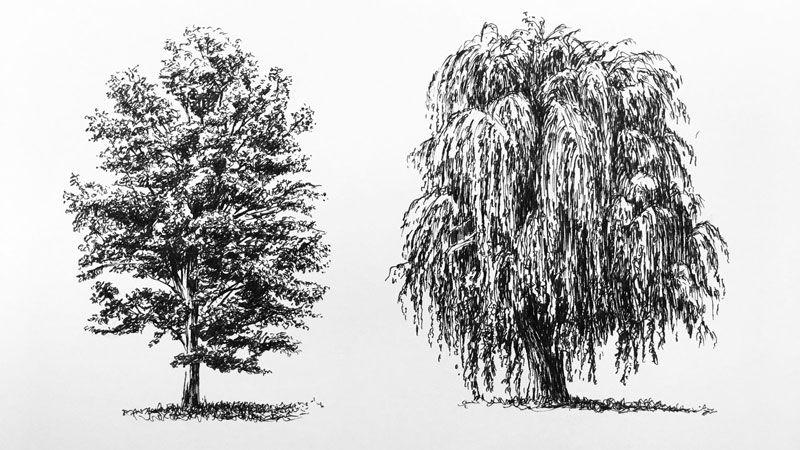
Once all of the ink applications have been made and allowed to dry completely, a kneaded eraser can be used to remove any of the graphite guidelines that may be visible.
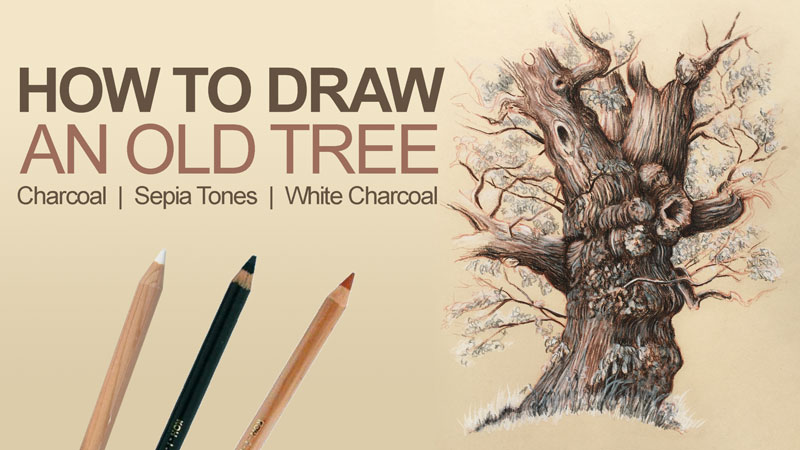
Every living thing has its own personality and trees are no different. As artists, part of our duty is to capture the personality of the subject - the character of the entity - in our drawings. This can be a daunting task if we allow ourselves to become overwhelmed with details or become too obsessed with realism. But if we look for bits of visual information that can be exploited in the form of a drawing, then we're likely to capture the character, resulting in a drawing that is accurate while still telling a visual story.
When it comes to trees, the character is often found in the shapes, lines, values, and textures - the same things that we would look for if our goal was to create a photo-realistic drawing.
The following video demonstrates the process of drawing an old tree with charcoal and sepia tones.
(Some of the following links are affiliate links which means we earn a small commission if you purchase at no additional cost to you.)
Charcoal, a black powdery medium from burnt organic material, and the reddish-brown tones of the color, sepia are a match "made in heaven". The earthy tones of any sepia material, whether it be pastel or conte, marry well with the rich darks produced by charcoal. And when you add a little white charcoal into the mix, a beautiful range of value and color can be achieved.
Simply put, sepia is a range of color from browns to reds. All sepia tones have a bit of earthy red and brown in them in varying degrees. Originally, sepia ink was widely-used as a writing ink in early Greek and Roman civilizations and was also used by artists - perhaps most famously, by Leonardo da Vinci.
Sepia tones are used in every artistic medium from photography to painting. They can be used as color enhancements in photos to make them appear older or as underpaintings. The softer tones produced by sepia colors add a touch of color to an otherwise monochromatic composition.
Sepia tones are often used alongside charcoal to soften the strong blacks produced the material. The reddish-browns also add a bit of color to the drawing, adding interest. Sepia tones are most effective when used for subjects that already have reds and brown in them naturally, such as portraits and landscapes.
In this lesson, we're working on toned Stonehenge paper (Fawn, Vellum surface). Stonehenge papers are 100% cotton which results in a soft surface. Softer surfaces naturally produce a softer mark which may be preferred by some artists.
We'll begin by lightly drawing the contours of the tree with a Red Chalk pencil from the Gioconda pencil line from Koh-i-noor. Although this pencil is labeled as a "chalk" pencil, it feels and behaves like an oil pencil.
The marks at this stage are light and loose as we try to find the boundaries of the subject. The most important element at this stage is the core of the trunk and the branches of the tree. We'll also exaggerate the contours a bit, making them bumpier. This will add some character to the tree and make it appear a bit older.
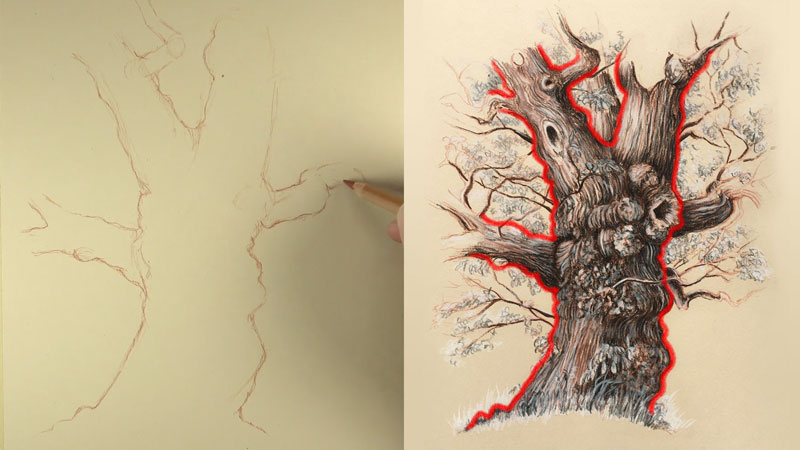
It may be helpful to think of the branches as tubes or cylinders. It's easy to add branches that extend from the edges of the trunk, but some of these should bend and turn towards and away from the viewer. Drawing the branches in this manner adds depth.
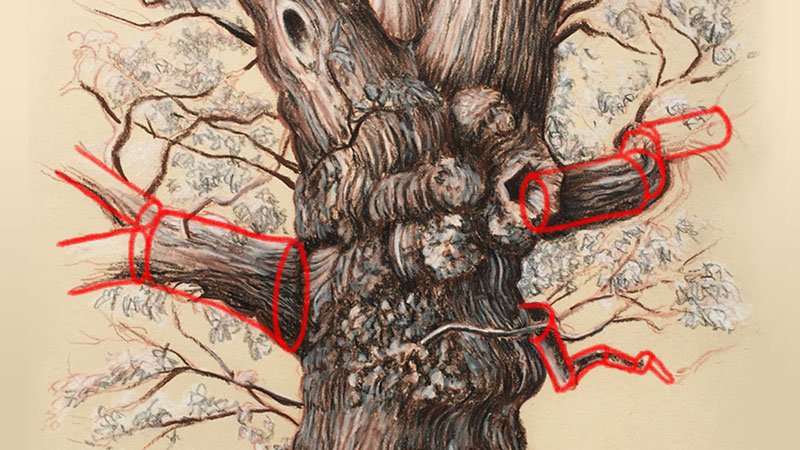
Once the contours are loosely sketched, we can enhance the line quality. Line quality refers to the thickness or thinness of the line. There should be some variety here. Generally, portions of the tree that are thicker can be defined by a thicker line. This means that we can revisit the core of the trunk and make the lines that define it a little thicker.
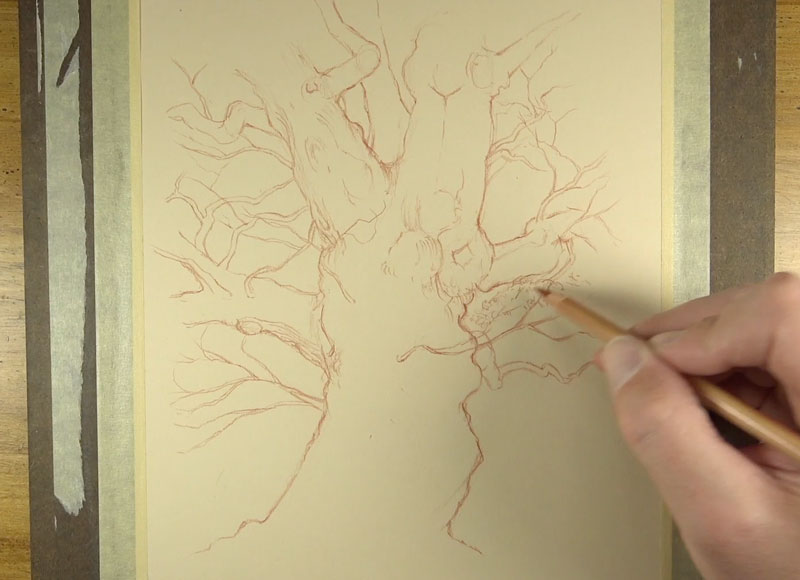
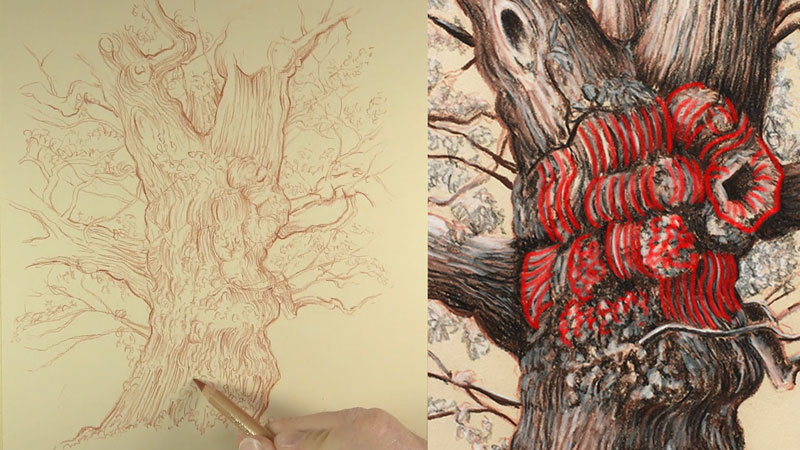
Now that the contours are in place, we can start to develop the texture on the trunk of the tree. Mostly, this texture is defined by line applications. The directional lines that we add here are important and should flow with the form of each section of the tree. Lines that flow over the form of the subject are referred to as "cross contour lines". It's important to point out that the texture of the tree changes throughout. In some areas the lines are predominantly straight, while in other locations the lines may be made up of smaller circles.
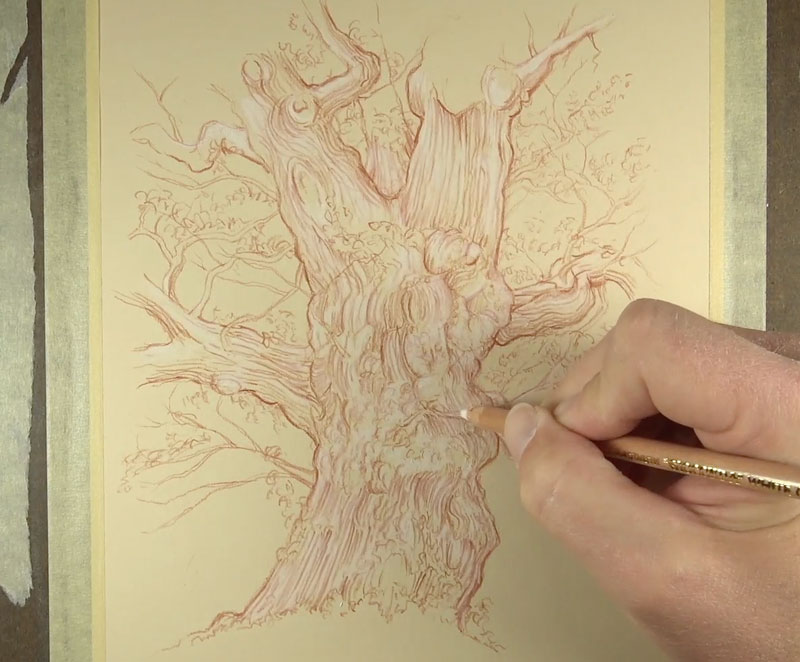
Now we're ready to begin addressing the value range. Value is the darkness or lightness of a color. Value communicates the form and texture of the subject. We'll start by applying an application of white charcoal over the majority of the tree. By doing this, we can preserve the lighter areas before developing the darker ones. The stroke of the mark should be considered here as well. Just like in the last step, we'll make marks that flow with the cross contours.
We'll begin introducing darker tones and midtones with a Sepia Light pencil from the Gioconda line. This pencil is powdery and behaves in a similar manner as a pastel pencil. Since the light source originates from the upper left, darker tones are concentrated on the right side of the tree. However, since the tree is curved, some darker tones are also found on the left side. Again, strokes applied with the pencil flow with the cross contours.
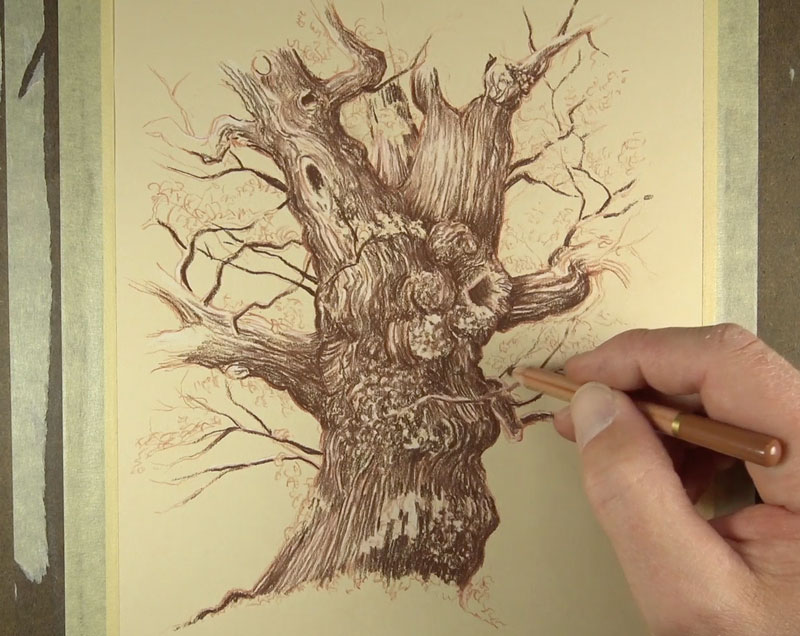
Before going even darker, the white charcoal pencil can be used to soften areas where the contrast may be too demanding.
Now we can push the darker tones with a charcoal pencil. We shouldn't cover the applications made with the Sepia Light pencil completely, but instead focus on the locations where the value should be very dark. Again theses locations exist on either side of the tree, but are more dominant on the side opposite from the light source.
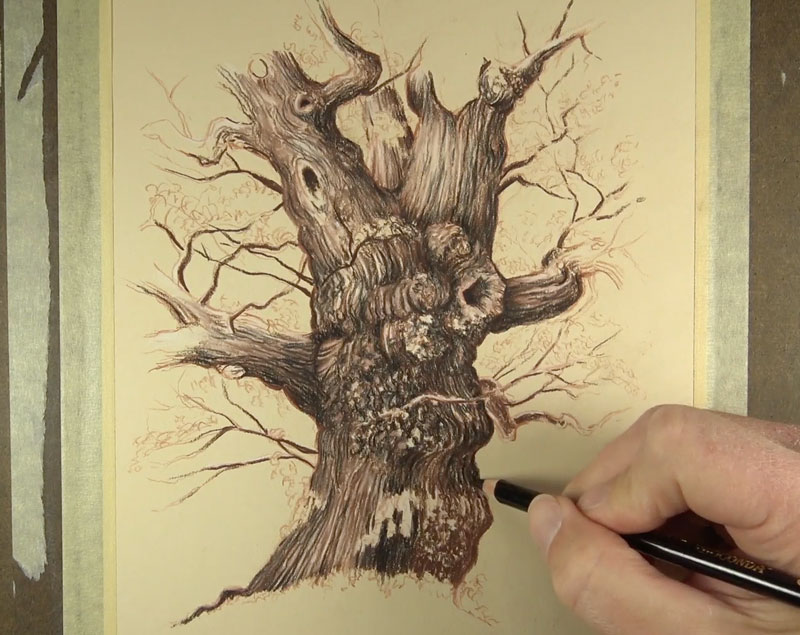
We can now go back with a sharpened white charcoal pencil and enhance the highlights further. This broadens the range of value and increases the contrast. Edges are then refined and blacks deepened using a Negro pencil.
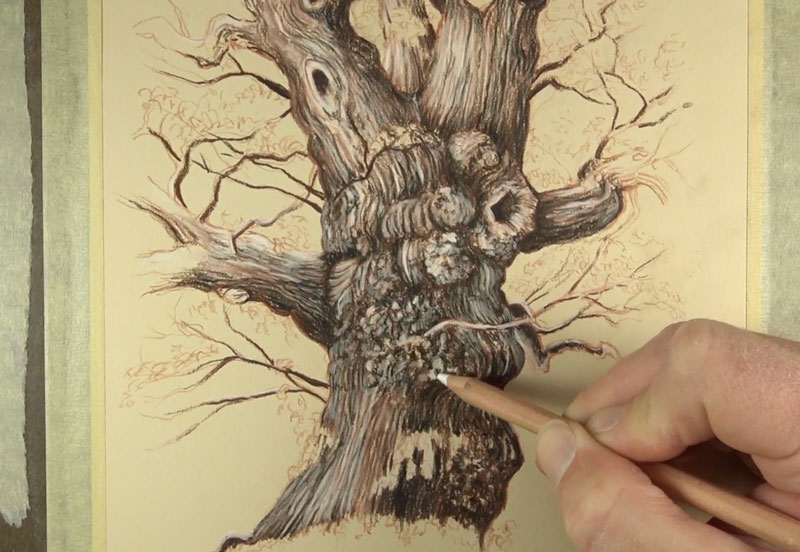
We can then fill in loose indications of leaves and grass at the bottom of the tree and throughout the canopy using a combination of the white charcoal pencil and Negro pencil to complete the image.
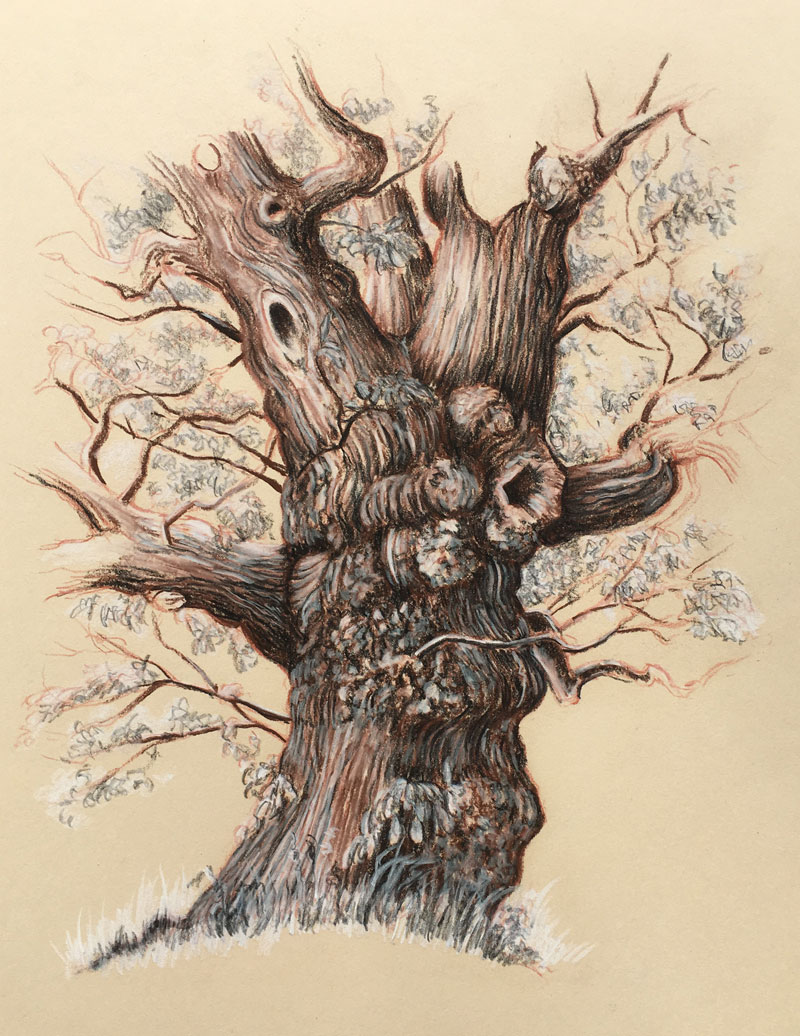
While the combination of charcoal and sepia tones can be used for any subject, they work best when applied to those that naturally contain reddish earth tones like our tree. The process is quick without sacrificing much control. And when it comes to drawing trees and capturing their character, focus on the basic shapes, lines, and textures - exaggerating them when possible.
Drawing is all about creating an illusion. We see the world around us as lines, shapes, forms, textures, and colors. This is how our eyes see things anyway. It is our minds that make sense of these things. Our mind tells us what we are seeing, not our eyes.
As artists, we are in the business of creating illusions. We rely on the manner in which our eyes work in order to “trick” the minds of those that view our art.
Problems typically arise when we allow our minds to get in the way of what our eyes are actually seeing.
Although, we are discussing how to draw a realistic tree in this tutorial, this concept of drawing applies to any subject that you may want to tackle.
(Some of the following links are affiliate links which means we earn a small commission if you purchase at no additional cost to you.)
When it comes to drawing trees, texture will play a crucial role. We will need to mimic the observed texture of the leaves of the tree, without drawing every single leaf. So, our goal is to create - you guessed it - an illusion.
This illusion is created by relationships of value. The positioning of the dark and light tones will not only give form to our tree, but also create the illusion of groupings of leaves. It is the contrast between the darks and the lights that will translate as individual leaves to our viewers.

Dark values will exist in shadowed areas, while light values will exist in areas that are receiving light.

Since we are building up the illusion with colored pencils, we will need to consider the value of the colors that are used. The leaves on the tree in this demonstration are green. We'll mix areas on the tree to create lighter and darker values using yellow, blue, brown, black, and white. Not only will this push the value range, but it will also expand the depth in the color.
The blue that is used is darker in value, so it is used to develop the shadowed areas of the tree.

Yellow is naturally a lighter value as a pure hue, so it is used in the areas that are receiving light. Darker values are enhanced using brown and black, while lighter values are enhanced using white.

The marks that are made are also important. Marks can be made to mimic the texture of the leaves using small irregular circles. Drawing each individual leaf would be counter-productive and is unnecessary. Remember, we are creating an illusion based on how how our minds perceive the world around us. These small marks will suffice to create this illusion.
We will also need to consider spaces that exist in the canopy of the tree. The tendency is to overlook these openings, but including them is incredibly important.

Of course, these open spaces provide more opportunities for drawing the branches that are visible, which add to the overall illusion that we are after.
Like with most colored pencil drawings, layering and building up colors is especially important. Most of the time, one application of color will not be enough to create the required depth in color to create a realistic appearance. Fortunately, colored pencils are easy to layer and blend nicely.
Start light when layering colors. It is much easier to build up colors when initial layers are applied with a light hand early in the drawing. Layering lightly in the early stages prevents build up of the binder which could hinder heavier applications applied later in the drawing process.
Be patient. Colored pencils are a medium that requires patience. It is a time consuming process to layer the pencils properly to create the required illusion. Too often, beginner artists expect immediate results, when time should be devoted to developing a colored pencil drawing.